Proximal Origin
On February 1, 2020, a teleconference brought together Anthony Fauci, Francis Collins, Wellcome Trust director Jeremy Farrar, and a group of virologists to discuss the genome of a new coronavirus. Six weeks later, some of the same scientists published the most-cited paper of the origins debate.
The record shows the call, the paper, the private correspondence released under FOIA, and the hearings and reports that later asked how the one became the other. It also shows the paper's published conclusion and its authors standing by it. Both readings are set out below, each with the evidence it rests on.
- February 1, 2020
Farrar/Fauci teleconference on the SARS-CoV-2 genome
Wellcome Trust director Jeremy Farrar convened a teleconference with Anthony Fauci, Francis Collins, and a group of virologists — including Kristian Andersen, Eddie Holmes, and Robert Garry — to discuss the genome and possible origins of SARS-CoV-2. Fauci emails released under FOIA in 2021 showed some of the participating scientists privately entertained lab-origin features in the days around the call; within weeks, call participants drafted the analysis published March 17, 2020 as 'The proximal origin of SARS-CoV-2.' Former CDC director Robert Redfield later testified he was sidelined from the call because of his views — a claim Fauci rebutted as having 'no basis in reality' — and the Select Subcommittee's 2024 final report concluded the paper was 'prompted by' Fauci and Collins, a finding that remains contested; the authors maintain the published analysis reflects their genuine conclusion.
- February 19, 2020
Lancet letter condemns lab-origin 'conspiracy theories'
Twenty-seven scientists condemned 'conspiracy theories suggesting that COVID-19 does not have a natural origin' and declared 'no competing interests.' Later disclosures (FOIA'd emails, USRTK) showed the letter was organized by Peter Daszak of EcoHealth Alliance, which funded coronavirus research at the Wuhan Institute of Virology. The letter anchored a year of media framing of lab-leak discussion as debunked; defenders say it reflected the genuine scientific mainstream view at the time, citing early genomic analyses as its basis.
- March 17, 2020
Nature Medicine publishes 'The proximal origin of SARS-CoV-2'
Andersen et al. concluded SARS-CoV-2 'is not a laboratory construct or a purposefully manipulated virus' and that they did not believe any laboratory-based scenario was plausible — the most-cited scientific basis for assertions that a lab origin was ruled out. Fauci emails released in 2021 showed some authors privately entertained lab features days before drafting; the authors and defenders maintain the published analysis reflects their genuine conclusion and that nothing in the emails shows it was falsified.
- February 8, 2021
Facebook expands COVID-19 removals to cover 'man-made' origin claims
Facebook announced it was expanding the list of false COVID-19 claims it would remove from Facebook and Instagram to include the claim that 'COVID-19 is man-made or manufactured,' following consultations with organizations including the WHO. The change was part of an existing COVID-19 misinformation policy Facebook had maintained since early 2020. The Supreme Court later noted, in Murthy v. Missouri, that Facebook announced this expansion in early February 2021, before Biden White House officials began communicating with the platform.
- May 14, 2021
Science letter: 18 scientists say lab and zoonotic origins 'both remain viable'
Bloom, Chan, Baric, Relman and colleagues wrote in Science that 'theories of accidental release from a lab and zoonotic spillover both remain viable,' criticizing the WHO joint study for devoting only 4 of 313 pages to the lab hypothesis. Widely credited with reopening mainstream permission to treat the lab leak as legitimate; signatories explicitly took no position on which hypothesis was more likely — cited by defenders as scientific self-correction working as intended.
- June 1–2, 2021
FOIA release of 3,200+ pages of Fauci emails ('#FauciEmails')
BuzzFeed News published more than 3,200 pages of Fauci's early-2020 emails obtained via FOIA lawsuit (the Washington Post separately published 800+ pages); '#FauciEmails' trended for days. The most-recirculated item was Fauci's Feb. 5, 2020 email to Sylvia Burwell advising store-bought masks were 'not really effective.' Critics read the release as evidence of a public/private gap on masks and origins; defenders and fact-checkers noted the emails were consistent with his contemporaneous public statements and reflected fast-evolving evidence.
- March 8, 2023
Redfield testifies he was excluded from origins discussions; asserts lab-origin view
At the Select Subcommittee's first origins hearing, former CDC Director Robert Redfield testified that he believed COVID-19 more likely resulted from a lab incident, that he was sidelined from the Feb. 1, 2020 Fauci/Collins call because of his views, and — under questioning — that NIH funded gain-of-function research. Fauci publicly rebutted the exclusion claim as having 'no basis in reality'; the minority witness testified there is no scientific consensus, and the ranking member warned against politicization.
- January 8–9, 2024
House SSCP transcribed interview of Fauci (14 hours)
Closed transcribed interview produced detailed questioning on origins messaging, EcoHealth, and definitions. Public hearing followed in June.
- December 2, 2024
House Select Subcommittee releases 520-page final report
After a two-year investigation (100+ letters, 30+ transcribed interviews, 25 hearings), the GOP-led Select Subcommittee's 'After Action Review of the COVID-19 Pandemic' concluded COVID-19 'most likely emerged from a laboratory in Wuhan,' criticizing mask guidance, lockdowns, school closures, vaccine mandates, and NIH oversight of EcoHealth Alliance, while praising Operation Warp Speed and Trump travel restrictions. Democratic members dissented from key conclusions, and several headline findings (e.g., the single-introduction argument and that 'Proximal Origin was prompted by Fauci') remain contested by scientists and unadjudicated.
- July 24–27, 2026
Release of 'Tony's Diary' — 1,141 pages of private notes
Paul released Fauci's private journal entries (Dec 2019–Dec 2022). Entries show early market-as-amplifier thinking, celebrity/fame notes, and private vs public tension on origins. HHS Sec. RFK Jr. stated notes found on government servers after multi-month search.
Paul position
Evidence increasingly points to a lab-related incident; alleged cover-up of early lab concerns and U.S. funding links.
Rests on
- February 1, 2020Farrar/Fauci teleconference on the SARS-CoV-2 genome
- March 8, 2023Redfield testifies he was excluded from origins discussions; asserts lab-origin view
- February 26–28, 2023WSJ: Energy Department shifts to lab-leak lean; FBI's Wray confirms lab-incident assessment
- December 2, 2024House Select Subcommittee releases 520-page final report
- July 24–27, 2026Release of 'Tony's Diary' — 1,141 pages of private notes
Fauci / NIH position
Natural origin more likely while favoring continued investigation; NIH collaboration with Chinese scientists was responsible surveillance of bat coronaviruses.
Rests on
- March 17, 2020Nature Medicine publishes 'The proximal origin of SARS-CoV-2'
- letterInvestigate the origins of COVID-19 (Bloom, Chan, Baric, Relman et al., Science)
- June 1–2, 2021FOIA release of 3,200+ pages of Fauci emails ('#FauciEmails')
- June 23, 2023ODNI declassified IC origins assessment
On the record: IC split historically; CIA (Jan 2025) shifted to low-confidence lab-lean. No definitive public resolution.
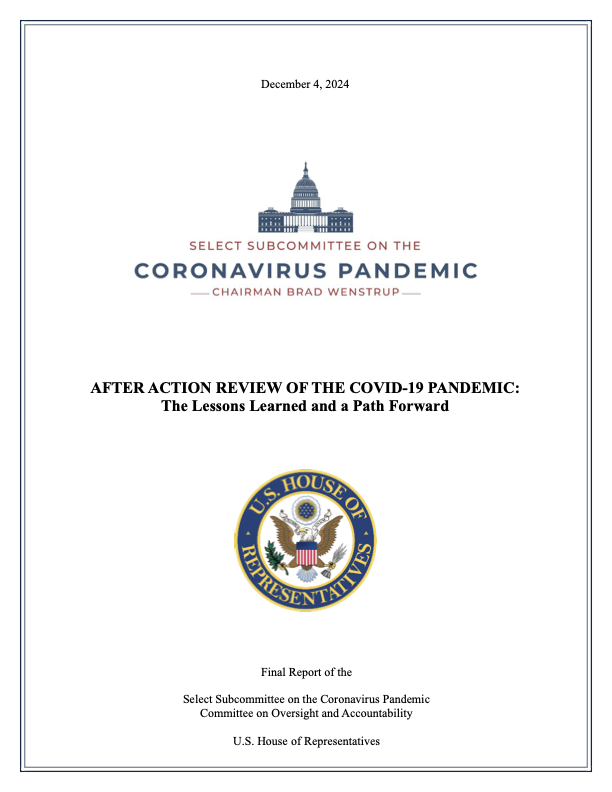
reportHouse SSCP Final Report — Dec. 2024
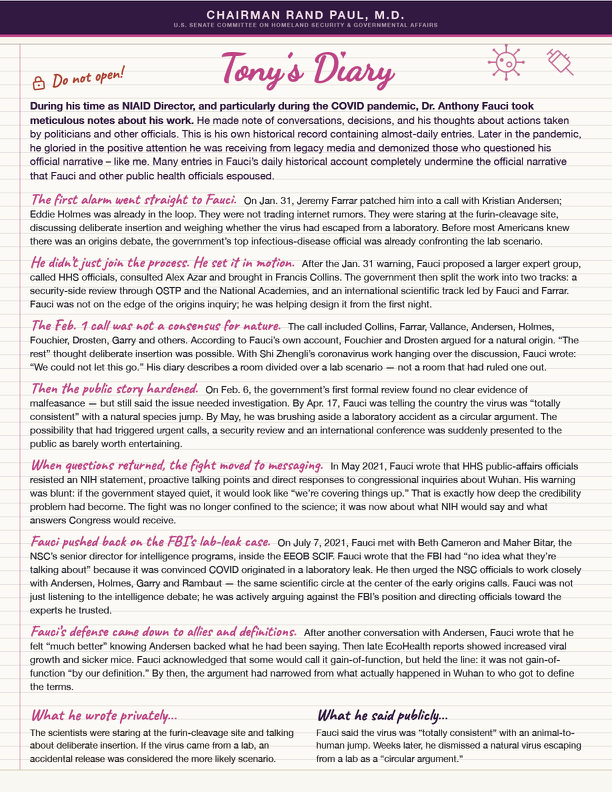
reportTony's Diary Package — released by Sen. Paul — July 2026
Anthony Fauci's Emails Reveal The Pressure On The Man Leading The Coronavirus Response (BuzzFeed News)
Published the 3,200-page FOIA email set itself
Fauci denies seeking to suppress COVID-19 lab leak origin theory (Fox News/AP)
Headlines Fauci's denial that he sought to suppress the lab-leak theory
FBI chief Christopher Wray says China lab leak most likely (BBC)
Reports the FBI's assessment that a lab incident was most likely
Rand Paul releases Anthony Fauci's pandemic-era diary notes (NPR)
Diary release coverage, with scientist cautions on early-uncertainty readings